AI UGC ads: the honest playbook for on-brand creative at scale
AI UGC ads let lean teams test creator-style video at volume. Here's the honest playbook for making them on-brand and keeping them on the right side of the FTC's rules.
Performance teams on paid social in 2026 aren't losing because their budgets are too small. They're losing because they can't make new creative fast enough to keep an audience from going numb to the last batch. UGC-style video (the handheld, talking-to-camera, product-in-hand look) is what keeps working, and AI is now good enough to produce it without booking a creator for every test. That's the appeal. It's also where a lot of teams quietly cross a line they didn't see.
AI UGC ads are user-generated-content-style video ads, the casual creator look, produced with AI avatars and product footage instead of a filmed person. You write a script, give the model a real product image and your brand inputs, and generate the clip. Done well, it's the fastest way for a lean team to test creative at volume. Done carelessly, it's off-brand, generic, or a fake testimonial waiting for a complaint. This playbook is the honest version: how to make AI UGC ads that look like you and stay on the right side of the rules.
What you'll have at the end
A repeatable way to turn one product image and one script into a batch of on-brand UGC-style clips (several hooks, formats, and markets), plus a short checklist that keeps every clip honest before you put spend behind it. You get a process you can run again next week, not one hero video you got lucky with.
What you need before you start
Three things make the difference between AI UGC that works and AI UGC that looks like everyone else's:
A clean product image: a real photo of the actual product, well-lit, on a plain background. This is the anchor for everything downstream, so it's worth getting right.
Your brand inputs: colors, logo, and a defined tone of voice, kept somewhere reusable rather than in one person's head. A brand kit is exactly this, the approved look and language that every generation should start from.
One claim you can actually back up. The script is built around a single message ("this bottle keeps drinks cold for 24 hours"), and that message has to be true. AI makes it trivial to generate a confident claim; it does nothing to make the claim defensible.
Step 1: Start from a real product image, not a text prompt
The most common mistake is describing the product in words and hoping the model draws it right. It won't, twice in a row. Text prompts leave gaps, and the model fills them differently every run: the label rewrites itself, the shape drifts, the color shifts a few degrees.
Anchor the generation to an image instead. Reference-image video models are built for this: Google's Veo documentation states you can provide "up to three images of a single person, character, or product" and the model "preserves the subject's appearance in the output video" (Google Cloud). That one change, image in rather than just words, is what makes the product on screen actually yours, and it's the same principle behind image-to-video for brand consistency.
Step 2: Write the script around one claim, in a real voice
Good UGC sounds like a person, not a brochure. Open with a hook in the first second: the problem, not the product. Keep it to one claim and one call to action. Write it the way someone would actually talk, with the rhythm of speech, not the grammar of a landing page.
Match the voice to your brand, not to the generic "excited reviewer" tone every AI UGC tool defaults to. If your brand is calm and dry, the script should be calm and dry. The format is borrowed; the voice still has to be yours.
Step 3: Pick an avatar, and decide how honest to be about it
This is the step the loudest AI UGC tools skip past, and it's the one that matters most. An AI avatar can present your product: talk to camera, hold it, demo it. What it cannot do is pretend to be a real customer giving a real review. That distinction is the whole game.
A presenter or spokesperson framing ("here's how our product works") is honest. A fabricated testimonial ("I've used this for months and it changed my life"), delivered by an avatar of a person who doesn't exist and never used the product, is a fake testimonial, exactly what the rules now prohibit (more on that in Step 6). Pick the avatar and the framing with that line in mind before you generate anything.
Step 4: Generate variations, not one hero
The advantage of AI UGC is ten decent clips you can test against each other, not one perfect one. Once your image, script, and avatar are set, vary the hook, the opening shot, the pacing, and the format. Let the data pick the winner instead of betting on your favorite.
This is the same volume-over-perfection logic behind the AI ad variants playbook: the team that tests the most angles, on-brand, usually wins paid social.
Step 5: Keep every clip on-brand with locked inputs
Variation is where brands drift. The moment you're generating ten clips, the questions multiply: did this one start from the approved product image or last month's? Are the colors right? Did the person doing Friday's batch use the same settings as Monday's?
The fix is structure, not discipline. Wire your brand inputs and product image into the generation as fixed steps, so every variation starts from the same anchor by definition. That's the difference between a coherent set and a pile of clips that each drift a little, the root cause behind why so much AI content looks off-brand.
Step 6: Review against the rules before you spend
Before any budget goes behind an AI UGC ad, run it past the line the law actually draws. In 2024 the FTC finalized a rule banning fake and AI-generated reviews and testimonials; it covers testimonials that "misrepresent that they are by someone who does not exist, such as AI-generated fake reviews," or someone who never used the product (FTC). Separately, the FTC's endorsement guides require disclosing any material connection between a brand and an endorser (FTC).
In plain terms: don't invent a customer, don't fake a review, and don't dress an ad up as an independent opinion it isn't. A presenter-style AI ad with a real, defensible claim is fine. A synthetic stranger swearing they love a product they never touched is the thing that draws complaints and penalties. If you're unsure which side a clip sits on, label it as an ad and keep the claims true. This is the same governance instinct behind AI content disclosure for marketing teams.
Variations on the core workflow
Once the base workflow runs, the same setup stretches in a few directions. Swap the script and avatar language to produce the ad in multiple markets without a new shoot each time. Re-cut the same clip into 9:16 for TikTok and Reels, 1:1 or 4:5 for feeds, and 16:9 for YouTube, so one generation feeds every placement. Or hold the product and avatar steady and rotate only the hook, building a hook-testing engine that runs on demand.
Common mistakes to avoid
Faking a testimonial. The single biggest risk, and the easiest to avoid: never have an avatar claim to be a real customer with a real experience they didn't have.
Letting the product drift. Skipping the reference image and re-prompting from text means the product changes shape between clips. Anchor it.
Shipping one hero instead of a batch. You're leaving the main advantage, cheap and fast variation, on the table.
Making claims you can't back up. AI will happily generate a bold promise. Substantiation is still your job.
Defaulting to the generic UGC voice. If every clip sounds like the same hyped reviewer, none of them sound like you.
The runnable version
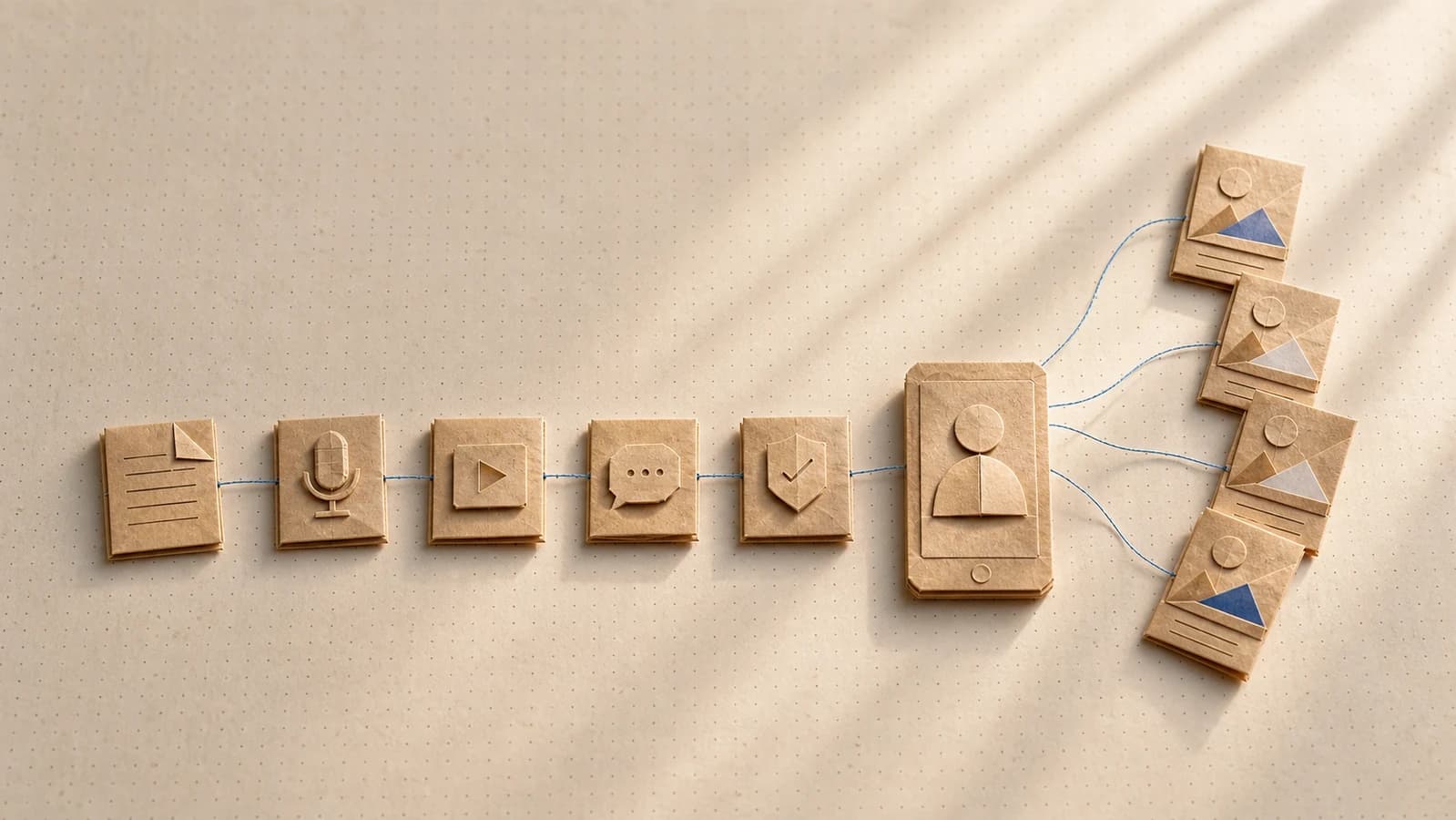
Steps are a starting point; a workflow is what makes this repeatable. On a visual canvas, the product image, brand inputs, script, and video step sit as connected nodes, so every run starts from the same approved anchor and produces an on-brand clip without you rebuilding the setup each time. Save it once and the whole team runs the same process; the output is consistent because the process is.
If you'd rather start from something built, the templates library is the fastest way in: open a UGC-style ad workflow, drop in your product image and brand kit, and generate your first batch. Set the workflow once, then run it every time you need fresh creative, which, on paid social, is always.
This is the calm version of the AI UGC story. Not a flood of synthetic strangers faking reviews, but a repeatable way to make creator-style ads that look like you, scale with your testing, and stay honest. The format is borrowed. The brand, and the responsibility for what it claims, stays yours.
This playbook is a pipeline.
Build it once on the canvas, wire in your brand kit, and rerun it every time the brief changes. Free to start, no card.
Common questions.
What are AI UGC ads?
AI UGC ads are user-generated-content-style video ads, the casual talking-to-camera or product-in-hand look, made with AI avatars and product footage instead of a filmed creator. They mimic the format that performs well on paid social, but you produce them from a script and a reference image rather than a shoot.
Do you have to disclose that a UGC ad was made with AI?
You can't pass off an AI avatar as a real customer giving a real testimonial. The FTC's 2024 rule prohibits fake or AI-generated consumer testimonials outright, and its endorsement guides require disclosing any material connection behind an endorsement. A presenter-style ad that doesn't claim to be an independent customer review is on safer ground. When in doubt, label it and never invent a testimonial.
How do you keep AI UGC ads on-brand?
Start every clip from the same approved inputs (a real product image, your brand colors and logo, and a fixed voice) instead of re-prompting from scratch each time. Reference-image video models hold a product's appearance steady across generations, and locking those inputs into a repeatable workflow keeps a whole batch consistent rather than just one clip.
Are AI UGC ads cheaper than hiring creators?
Usually yes, because the cost shifts from per-video production to per-generation compute, and you can produce many variations from one setup. The real saving is speed: you can test ten hooks in the time a creator shoot takes to schedule. The trade-off is that quality and trust now depend on your inputs and your honesty, not on the creator.