Structured prompting for AI video: the format behind consistent clips
Vague prompts hand you a different video every run. Structured prompting — named components, formulas, and JSON — is how marketing teams make AI video output consistent and repeatable enough to ship.
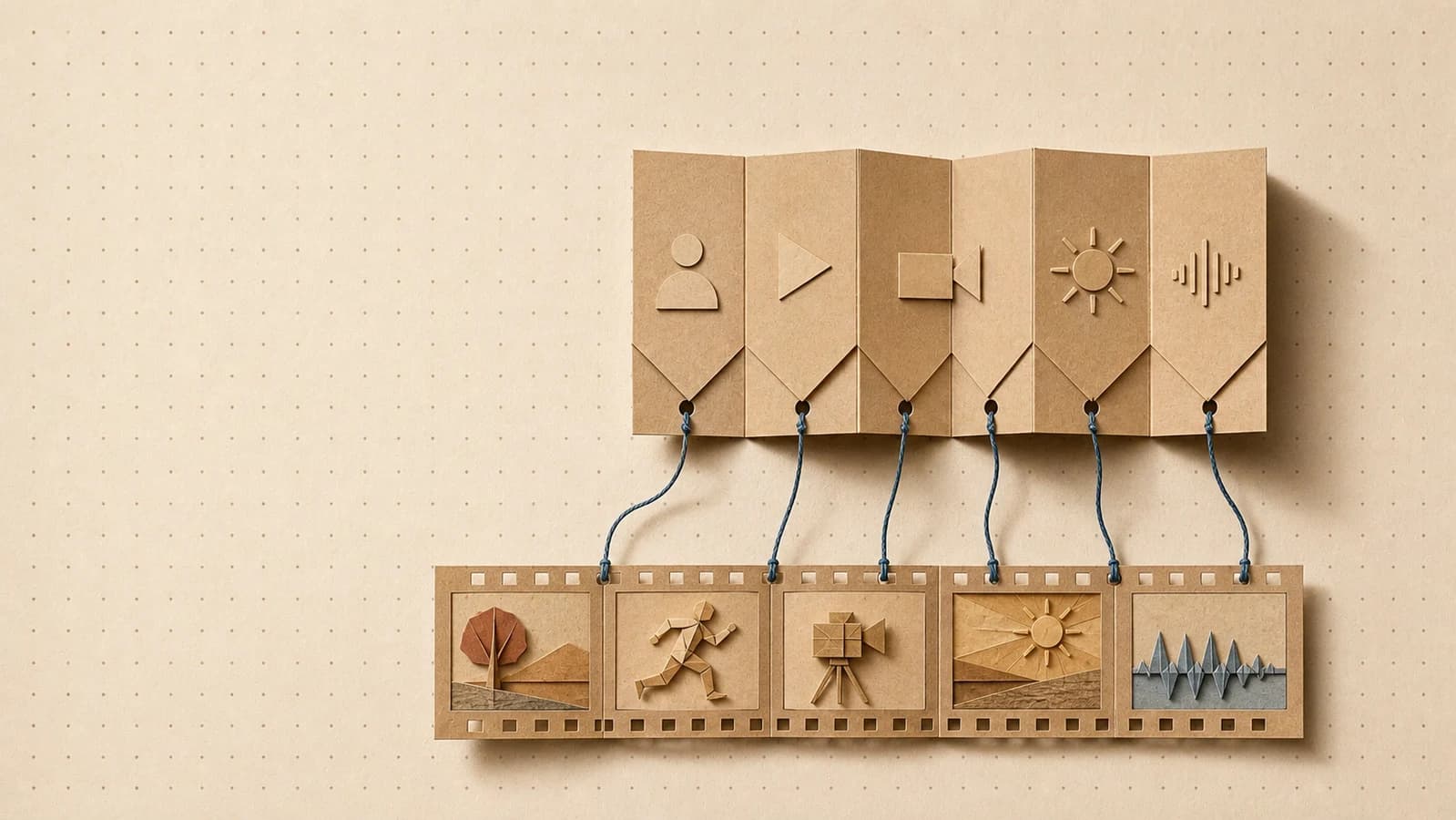
Ask an AI video model for "a coffee brand ad, upbeat" and you'll get a different clip every time you run it: different framing, different pacing, none of it quite what you pictured. Structured prompting fixes that by writing the prompt as named components (camera, subject, action, setting, lighting, audio) instead of one loose sentence. Spelling out each part of the shot gives the model less to guess at, which is what makes the output consistent enough to actually use at work.
This is the technique behind the "JSON prompting" posts filling your feed in 2026. The format gets the attention, but the format isn't the point. The point is structure: telling the model what every part of the shot should be, in fields you can reuse. Here's how it works, when JSON earns its keep, and how to turn a good prompt into a repeatable one.
Why does the same prompt give a different video every time?
Because that's how the models are built. Most text-to-video systems generate each clip from scratch, so running the same prompt twice returns two different takes, and the major labs treat that as a feature, not a bug. OpenAI's own Sora guidance puts it plainly: "using the same prompt multiple times will lead to different results," and frames prompting as "briefing a cinematographer who has never seen your storyboard" (OpenAI).
A vague prompt widens that swing. "Upbeat coffee ad" has thousands of valid interpretations, so the model picks a different one each run. The fix isn't a magic phrase. It's removing the ambiguity. The same OpenAI guide notes that "highly descriptive prompts yield more consistent, controlled results, while lighter prompts can unlock diverse outcomes." For marketing work, where the brief is fixed and the brand is non-negotiable, you almost always want the controlled end of that dial.
What does a structured AI video prompt look like?
Structure means breaking the shot into its parts and writing each one on purpose. Google's official Veo 3.1 prompting guide is explicit about the payoff: "A structured prompt yields consistent, high-quality results," and it offers a five-part formula: [Cinematography] + [Subject] + [Action] + [Context] + [Style & Ambiance] (Google Cloud).
In practice, a structured prompt names these elements:
- Camera and shot: the framing and any movement: "medium shot, slow dolly in."
- Subject: who or what the shot is about, described specifically.
- Action: what the subject does, in concrete verbs.
- Setting: where it happens, with the background detail that sells it.
- Style and lighting: the look and mood: "warm morning light, shot on film, slightly grainy."
- Audio: for models with native sound, dialogue in quotes, sound effects, and ambient noise, each called out separately.
Compare the two ways to ask for the same thing:
| Vague prompt | Structured prompt | |
|---|---|---|
| What you write | "Coffee ad, cozy, someone enjoying a latte" | "Close-up, shallow depth of field, hands wrapping around a ceramic latte cup on a wooden café table, steam rising; warm morning light through a window; calm, inviting mood; ambient noise: quiet café murmur" |
| What you get | A different scene every run | The same kind of scene, run after run |
| What you can change | Everything, unpredictably | One field at a time, on purpose |
The structured version is longer, but every extra word is a decision you've taken away from the model. That's the trade: more upfront specificity for less surprise on the other end.
So is JSON prompting actually better?
Not in the way the hype implies. Writing your prompt as a JSON object ({"camera": "...", "subject": "...", "audio": "..."}) does not make a single clip look better than the exact same details written as clean prose. The model reads the content, not the curly braces. If someone promises that JSON unlocks a hidden quality tier, be skeptical.
What JSON genuinely buys you is repeatability. When your prompt is a set of labeled fields, you can hold most of them fixed and swap one value (change "setting" from "café" to "office," keep camera, lighting, and mood identical) without rewriting the whole thing or accidentally dropping a detail. That's the difference between making one clip and making forty on-brand variants. For a single hero shot, organized prose is fine. For batch production, fields you can template win.
The honest framing, then: structure is the durable principle; JSON is just one way to enforce it. Google's guide makes a related point: a single detailed prompt is powerful, but "a multi-step workflow offers unparalleled control by breaking down the creative process into manageable stages." Whether you store that structure as prose, a checklist, or JSON matters far less than having it at all.
When structure helps, and when to loosen up
Tight structure is right when the outcome is fixed: brand work, ad variants, anything where "consistent with the last ten" is the whole job. Lock the fields and run.
Loosen up when you're exploring. Early in concepting, an over-specified prompt boxes the model into your first idea before you've seen anything surprising. The OpenAI guide notes that "leaving certain elements open-ended will encourage the model to be more creative." A useful rhythm: prompt loose to discover a direction, then lock the structure once you've found the shot worth repeating. The mistake is using the loose, exploratory style for production work and then wondering why nothing matches.
How structured prompting becomes repeatable in practice
A structured prompt living in a text file still depends on someone pasting it correctly every time. That's where consistency quietly breaks. The reliable version makes the structure part of the workflow, not part of someone's memory.
That's the whole idea behind a node-based canvas: the prompt's fields become inputs you set once (the camera and style for your brand, the model, the audio direction), and every run flows through the same steps. Swap the one field that changes for this campaign, and the tenth clip comes out matching the first instead of looking like a different company made it. Save that canvas as a template and the structure is now a shared asset your whole team runs, not a paragraph one person guards.
Structured prompting is also what makes the rest of an AI content workflow hold together. It pairs naturally with making AI content repeatable, and once your prompt is organized by component, choosing the right video model for the job is just a matter of pointing the same structure at a different engine.
The shift is small but it changes the economics: you stop writing prompts and start designing them once, then running them. For a team producing video at volume, that's the line between AI as a slot machine and AI as a process you can actually count on.
See the whole workflow.
Every step on Orisu is a node you can see, rewire and rerun. Templates are real share pages — open one and inspect the graph.
Common questions.
What is structured prompting for AI video?
Structured prompting is writing an AI video prompt as named components — camera, subject, action, setting, lighting, audio — instead of one loose sentence. By spelling out each part of the shot, you give the model less room to guess, which makes the output more consistent and easier to repeat across many clips.
Does JSON prompting make AI video better?
JSON doesn't make a single clip look better than the same details written as clear prose. What it buys you is repeatability: a JSON template has fixed fields you can swap one value in without rewriting the whole prompt, which is what makes batch and on-brand production reliable. For a one-off clip, well-organized prose works just as well.
Why do I get a different video every time I use the same prompt?
Most video models generate each clip fresh, so the same prompt yields different results by design. Vague prompts make the swing wider because the model fills the gaps differently each run. Tightening the prompt with specific camera, lighting, and action details narrows that range, though it never removes randomness entirely.
What should an AI video prompt include?
At minimum: the shot and camera move, the subject, the action, the setting, and the mood or lighting. For models with native audio, add dialogue in quotes, sound effects, and ambient noise. Naming these elements explicitly is the difference between directing the model and hoping it guesses what you meant.


