From prompt to pipeline: making AI content repeatable
Teams climb the same ladder: one-off prompts, saved prompts, prompt chains, visible pipelines. What breaks at each rung, and the three properties that make AI content actually repeatable.
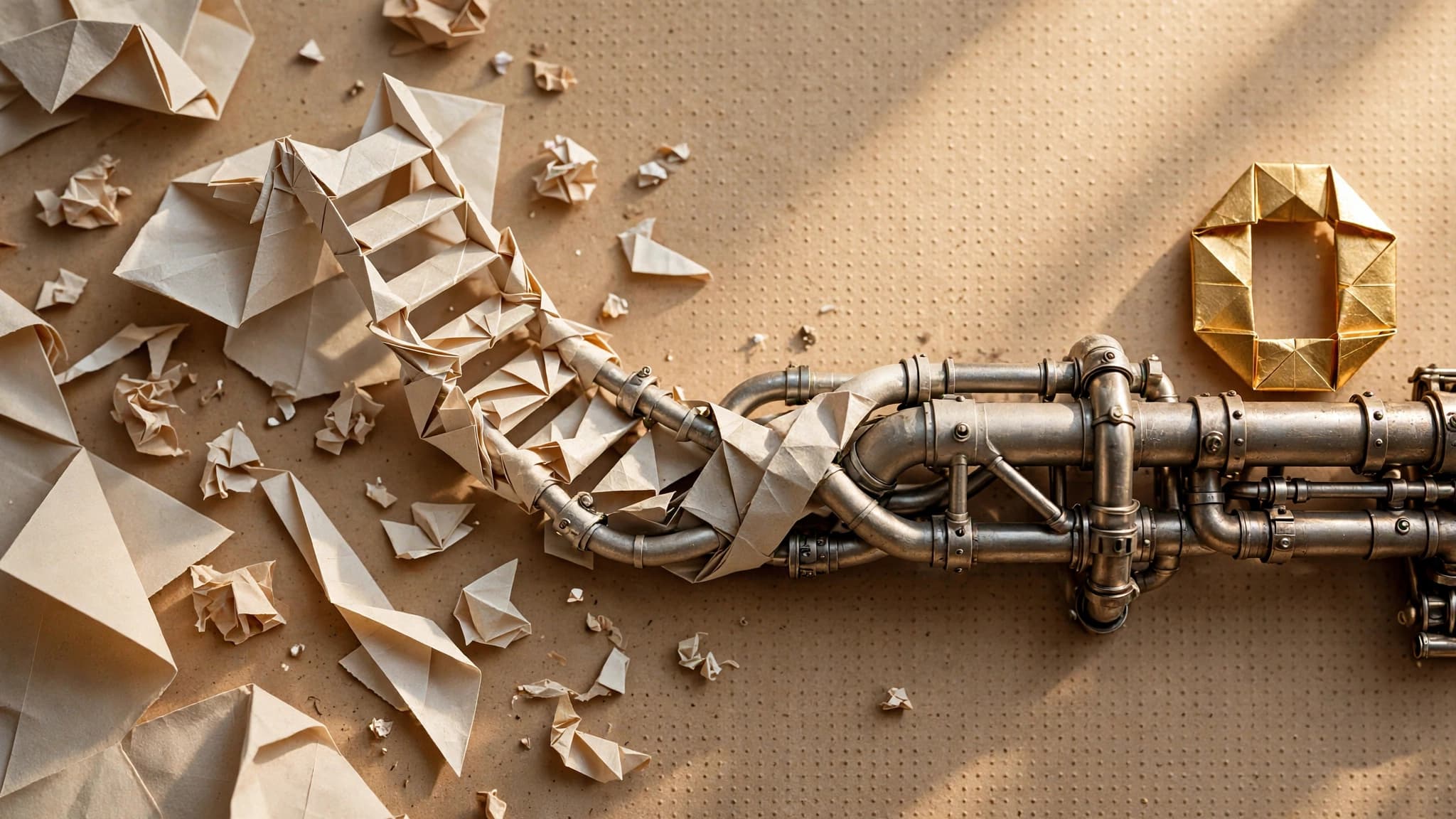
Making AI content repeatable means moving the process out of chat threads and into a pipeline: named inputs, steps in a fixed order you can inspect, and reruns that don't start from zero. Most teams climb the same four-rung ladder to get there, and each rung breaks in a predictable way.
The key idea: a prompt gives you an output, while a pipeline gives you the process behind it, and only a process can be repeated. Here's the ladder, rung by rung.
What does the prompt-to-pipeline ladder look like?
| Rung | What it is | What breaks |
|---|---|---|
| 1. One-off prompts | Chat threads, fresh each time | Memory: nothing survives the thread |
| 2. Saved prompts | A doc of prompts that worked | Consistency: same words, different hands, different results |
| 3. Prompt chains | Output of one prompt feeds the next, by hand | Handoff: the order and glue live in one person's head |
| 4. Visible pipelines | The process as an executable, inspectable graph | Much less: iteration cost finally drops |
Each rung is a real improvement on the one below it. The trouble is that teams tend to stall on rung 2 or 3 and conclude "AI doesn't scale for us," when the actual problem is the rung.
Rung 1: one-off prompts, where memory breaks
Everyone starts here, and should. You open a chat, describe what you want, push back a few times, and copy out the good result. For exploration, figuring out what you even want, nothing beats it.
The breakage is memory. When the thread ends, everything that made the output good ends with it: the phrasing that finally worked, the reference image, the correction that fixed the tone. Next week's version starts from zero. The work repeats, but nothing about the process does. You're paying full price for every output, forever.
The first time someone says "what did we prompt last time?", you've outgrown this rung.
Rung 2: saved prompts, where consistency breaks
So you start saving what worked: a doc, a Notion page, a shared library of prompts with notes. This is genuine progress: the phrasing survives, and new teammates have somewhere to start.
What breaks now is consistency. The same saved prompt, run by two people, produces different results: different threads, different follow-ups, different judgment about which output to accept and how to fix the rough edges. Part of that variance is the model itself: Anthropic's API documentation notes that even with randomness turned all the way down to a temperature of 0.0, "the results will not be fully deterministic." But most of it is human. The prompt was never the whole process; it was the visible part. The invisible part (sequencing, retries, taste) still lives in each person's hands.
Saved prompts also rot quietly. Someone improves a prompt in their own chat and forgets to update the doc. Models change and old phrasing stops working. Within a quarter, the library is a museum: in our experience, nobody fully trusts a prompt doc that's more than a few weeks old.
Rung 3: prompt chains, where handoff breaks
The next move is chaining: the output of one prompt becomes the input of the next. Summarize the blog post, turn the summary into hooks, turn each hook into an image brief, generate the images. Real structure appears for the first time: the work has steps, and the steps have an order.
But the chain runs by hand. Someone pastes output A into prompt B, carries B's result over to the image tool, downloads, re-uploads, keeps the order straight, and knows that step three always needs a second attempt. That someone is now load-bearing. When they're on holiday, the chain stops. When they leave, it leaves with them.
Handoff is the obvious break; iteration cost is the quiet one. Change anything early in the chain, like a new angle in the summary step, and every downstream step must be re-run, manually, in order. So people don't iterate. The chain calcifies, not because it's good, but because touching it is expensive.
Rung 4: visible pipelines, what finally changes
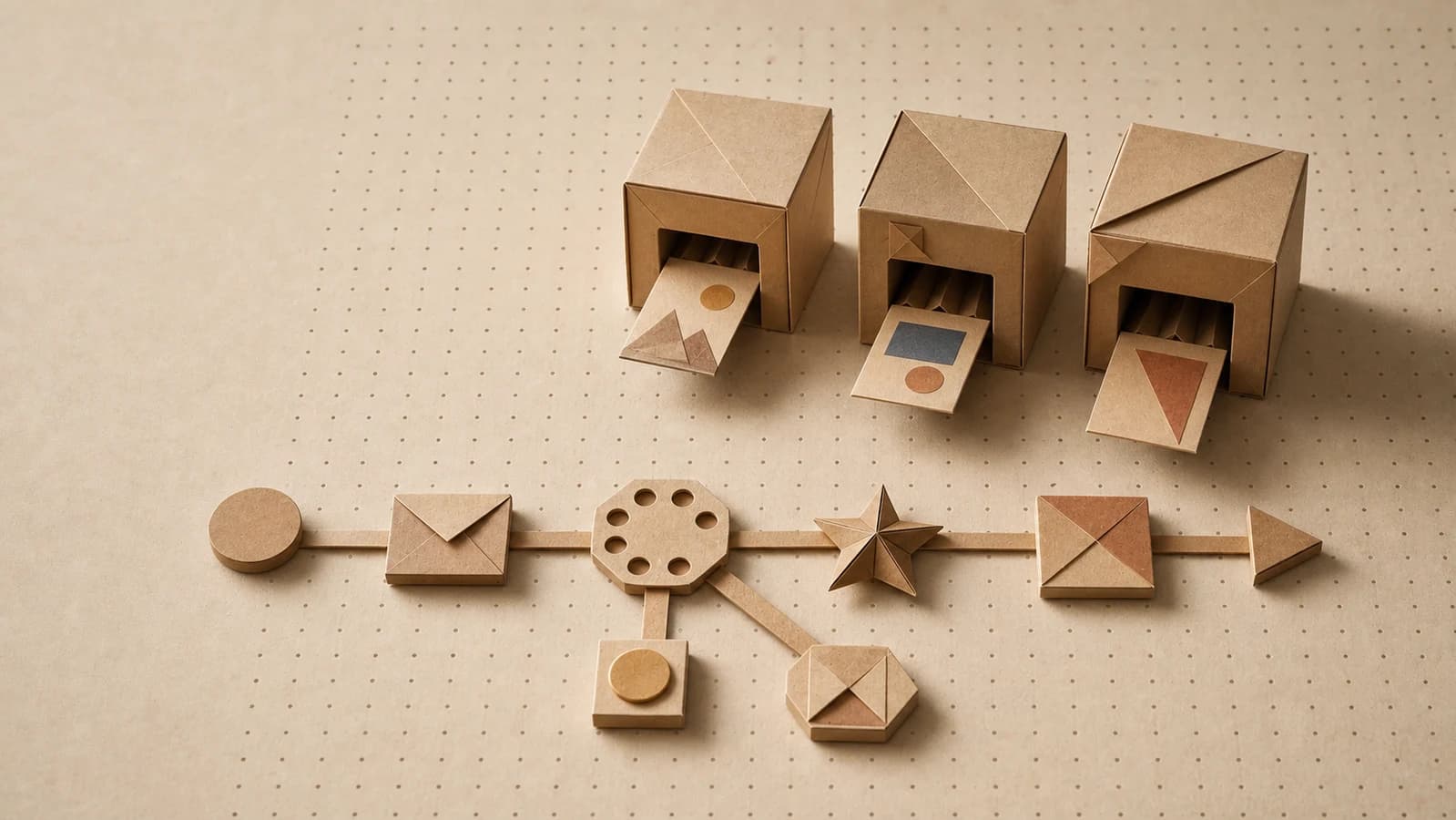
The top rung makes the process itself the artifact. The chain stops being a ritual one person performs and becomes a graph anyone can see: each step a node, each handoff a connection, the whole thing executable with one run. Data engineers have built pipelines this way for years. Apache Airflow's documentation describes a pipeline as a graph that "encapsulates everything needed to execute a workflow": which steps run, in what order, and what depends on what. (This is the canvas paradigm; What is a visual AI canvas? covers it from scratch.)
What's actually different is not that it looks like a diagram. It's that the three things the lower rungs lost (memory, consistency, handoff) become properties of the system instead of efforts of a person. The phrasing, the order, the glue between steps: all of it is in the graph, where it can't be forgotten, varied by accident, or trapped in someone's head.
What are the properties of a real pipeline?
Three things separate a pipeline from a tidied-up chain. They're worth checking your own setup against.
Named inputs. The things that change per run (the product photo, the brief, the launch date) are explicit, labeled entry points, separate from everything that stays fixed. The test: a teammate can run the pipeline knowing only the inputs, without reading a single prompt inside it.
Inspectable steps. When the result is wrong, you can open the pipeline and see what each step received and produced, then fix the one step that misbehaved. In a chat thread, debugging means rereading the transcript. In a pipeline, it means looking at the node.
Cheap reruns. Changing one step shouldn't mean redoing everything. A pipeline that recomputes only what changed turns iteration from "redo the afternoon" into "adjust, run, compare." This is the property that makes pipelines improve over time: when trying a variation costs almost nothing, people actually try variations.
There's a fourth property we'd add for brand work specifically: shared context, applied everywhere. If brand colors, voice, and style are pasted into individual prompts, they're a consistency bug waiting to happen; if they're a layer the whole pipeline reads from, they can't drift. We've written about that side separately in how to keep AI images and video on brand.
When is a pipeline overkill?
Honest answer: often. One-off work belongs in chat; if you'll never produce that shape of output again, building a pipeline is procrastination with extra steps. The exploration phase of a new idea also belongs in chat, where being unstructured is the advantage.
The signal to climb the ladder is recurrence. When you can say "every time we get X, we produce Y," and it's happened three or more times, the rung-1 costs start compounding and the pipeline pays for itself. Until then, prompt freely.
How does this look in Orisu?
Orisu's canvas is rung 4 built as a product, so the mapping is direct. The pipeline is a visible graph: image, video, text, and audio steps on one canvas, so chains don't break at tool boundaries. Inputs are explicit nodes a teammate fills in before hitting run. Every step's inputs and outputs are inspectable on the node itself. And reruns recompute only the steps whose inputs changed, which is what makes iteration cheap in practice. A finished pipeline can be saved as a runnable template, which solves the handoff problem by making the process the thing you share. There's a free tier if you want to take one recurring chain and fold it into a graph.
Once you're ready to build one properly, defining the recurring output, mapping steps, and placing review, the full method is in the pillar guide: How to build an AI content workflow.
See the whole workflow.
Every step on Orisu is a node you can see, rewire and rerun. Templates are real share pages — open one and inspect the graph.
Common questions.
What is the difference between a prompt and a pipeline?
A prompt is one instruction to one model; its result depends on who typed it and what came before it. A pipeline is the whole process made explicit: named inputs, steps in a fixed order, and an output you can reproduce by running it again. The prompt is one step inside the pipeline.
Why do prompt chains break down for teams?
A prompt chain still runs by hand: someone pastes each output into the next prompt, in the right order, without skipping steps. That knowledge lives in one person's head, so the chain can't be handed off, and one small change means re-running everything downstream manually.
What makes an AI workflow repeatable?
Three properties: named inputs (the things that change per run are explicit), inspectable steps (you can see what each step received and produced), and cheap reruns (changing one step doesn't force redoing the rest). A process with all three can be run by anyone and improved without breaking.
When is a pipeline overkill?
When the work is genuinely one-off. If you'll never produce that shape of output again, a chat thread is faster and better, because exploration is what chat is for. Build a pipeline once you can name an input and an output set that recur, roughly three or more times with the same shape.