What is MCP? The Model Context Protocol, explained for marketing teams
MCP, the Model Context Protocol, is the open standard that lets AI assistants plug into your real tools and data. Here's what it means for marketing teams, and when to use it.
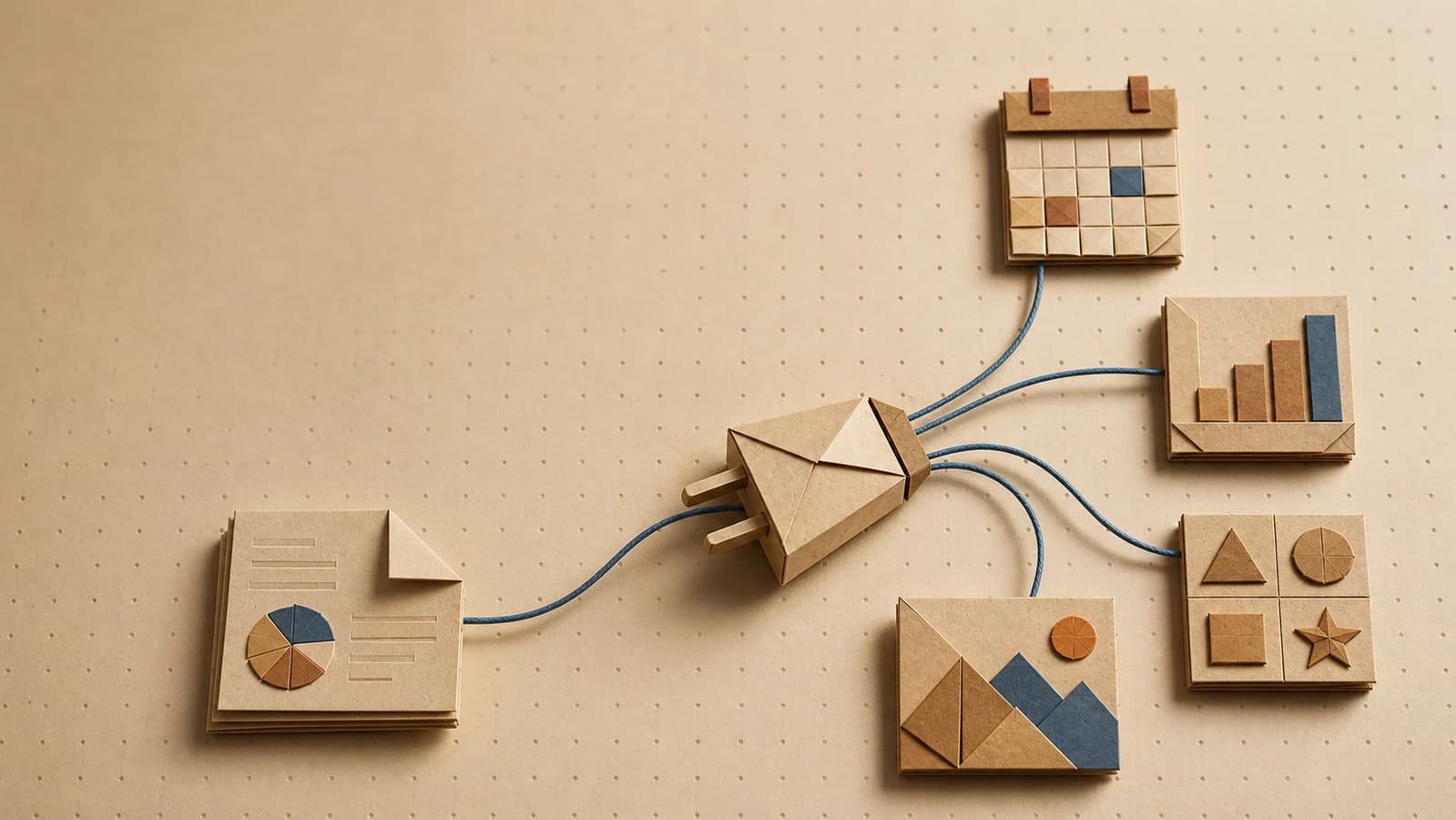
If you've spent the last year watching AI assistants get smarter while still being unable to see your actual brand kit, your actual analytics, or your actual content calendar, MCP is the part that fixes that gap. It's the reason your AI is about to stop being a clever stranger and start being a coworker who knows where things are.
MCP, the Model Context Protocol, is an open standard for connecting AI assistants to the systems where your data and tools live. Anthropic introduced it in November 2024 as "a new standard for connecting AI assistants to the systems where data lives, including content repositories, business tools, and development environments," built to replace "fragmented integrations with a single protocol" (Anthropic). In plain terms: instead of building a one-off connection between every AI app and every tool you use, you build against one shared method, and any AI assistant that speaks MCP can use it.
Why MCP showed up now
For most of the AI boom, the models got better in a vacuum. They could write a caption or describe an image, but they couldn't reach into your Google Drive, your CRM, or your brand guidelines without a custom integration someone had to build and maintain. Every new tool meant another bespoke connector. Anthropic called this the "N×M" problem: N AI apps times M tools is a lot of plumbing, and most of it never gets built.
MCP collapses that. Connect a tool to MCP once, and every MCP-aware assistant can use it, with no separate hookup per app. That design is why adoption moved fast: after Anthropic released it, OpenAI adopted the standard in March 2025 and Google DeepMind followed in April 2025, and in December 2025 Anthropic donated MCP to a Linux Foundation effort to keep it neutral and open (Wikipedia). When rivals agree on the same plug, it stops being one company's feature and starts being infrastructure.
How does MCP actually work?
The shape is simple, and you don't need the internals to use it, but the picture helps. There are two sides. A server exposes a tool or data source: your asset library, your analytics, your content management system. A client is the AI app you actually talk to. MCP is the shared language between them, so the assistant can ask "what's in here?" and "do this" in a way any compliant server understands.
The connection is two-way. The assistant can read (pull your brand colors, last month's top-performing posts, the product photos in a folder) and it can act (draft the post, kick off a generation, file the asset back where it belongs). Once that link exists, you stop copy-pasting context into a chat box. The assistant already has it.
For a marketing team, the mechanic that matters is this: the context travels with you. Instead of re-explaining your brand and re-uploading the same files in every session, the assistant reaches the source directly, every time, through the same connection.
What MCP changes for marketing teams
The practical shift is from "AI that describes work" to "AI that does work in your stack." A few concrete examples of what the connection unlocks:
Pull your real brand inputs into a generation without uploading them by hand. The colors, fonts, and voice already live somewhere, and MCP lets the assistant read them at the source. Ask plain-language questions of your analytics ("which three posts drove the most signups last month?") and get an answer grounded in the actual numbers, not a guess. Trigger a content workflow from the tools you already use, so a new brief in your project tracker can start asset production without anyone opening another app.
None of this is new capability in the model. It's access. MCP is the difference between an assistant that can write a good caption and one that can write a good caption about your product, in your voice, and post it where it goes, because it can finally see all three.
MCP vs APIs, plugins, and integrations
These get used interchangeably, but they solve different layers of the same problem.
| Approach | What it is | The catch |
|---|---|---|
| API | A way for two pieces of software to talk directly | You build and maintain each connection yourself, per tool, per app |
| Plugin | A prebuilt add-on for one specific product | Lives inside that product; doesn't transfer to other assistants |
| Custom integration | A bespoke hookup between your stack and one AI app | Breaks when either side changes; every new app starts over |
| MCP | An open standard many assistants and tools all speak | Build the connection once; any MCP-aware assistant can use it |
The honest summary: APIs still do the real work underneath. MCP is the agreed-upon way to expose them to AI assistants so the same connection isn't rebuilt for every new tool. It's less a replacement than a shared socket everyone now plugs into.
When you need MCP, and when you don't
MCP earns its keep when work crosses tools and repeats. If your team produces content at volume, pulls from a shared asset library, and reports against real numbers, a standard that lets your AI reach all of that directly removes a real, daily tax. The same is true if you want to drive production from code or from another app in your stack rather than clicking through a UI each time.
You don't need to think about MCP if your AI use is occasional and self-contained, like a one-off caption, a quick image, or a brainstorm. There's nothing to connect, so there's nothing to gain from a connection standard. And MCP is not magic: a connection that can read and act on your systems is powerful, which means it deserves the same care you'd give any tool with real access. Grant it deliberately, scope it to what it needs, and treat permissions as something you decide, not something you wave through.
How MCP looks in Orisu
Orisu is built around repeatable workflows on a visual canvas: you connect the steps (brand inputs, image, video, text) and save the whole thing as a runnable template. MCP is how that canvas opens up to the rest of your stack. Technical teammates can connect Orisu through MCP and trigger workflows programmatically, so a campaign brief living in your project tracker can kick off asset production without anyone opening the app. It's the same "wire it into your own pipeline" path described in how to build an AI content workflow and the agent-driven approach in AI content agents for marketing teams.
The framing fits the rest of the product. App Mode hands a finished workflow to teammates who never touch the canvas; MCP hands it to the code and tools the technical side already runs. Same workflow, same on-brand output, reached two different ways. If you want to see the canvas those connections run on, the templates library is the fastest way in. Open one, swap in your brand, and run it.
MCP won't make your content better on its own. What it does is remove the wall between a capable AI assistant and the place your real work lives. For a marketing team, that wall is most of the friction, and a standard that quietly takes it down is worth understanding before everyone around you assumes you already do.
See the whole workflow.
Every step on Orisu is a node you can see, rewire and rerun. Templates are real share pages — open one and inspect the graph.
Common questions.
What is MCP in simple terms?
MCP, the Model Context Protocol, is an open standard that lets an AI assistant connect to your real tools and data through one shared method instead of a custom hookup for each. Think of it as a common plug: build a connection once and any MCP-aware assistant can use it.
Who created MCP and who uses it?
Anthropic created MCP and released it as an open standard in November 2024. Since then other major AI providers have adopted it, including OpenAI in March 2025 and Google DeepMind in April 2025, and in December 2025 Anthropic donated it to a Linux Foundation effort. That broad backing is why it matters now.
Do marketing teams need to know how to code to use MCP?
No. MCP is plumbing, not a tool you sit in front of. Someone technical sets up a connection once; after that you work in plain language inside your AI assistant. The point of MCP is to hide the wiring so non-technical people get the benefit without touching it.
Is MCP the same as an API or a plugin?
Not quite. An API is a way for software to talk to software, and a plugin is usually tied to one product. MCP is a shared standard that sits on top: one protocol many AI assistants and many tools all speak, so a connection built once works across them instead of being rebuilt for each.


