Consistent AI characters: how to keep a brand mascot on-model
AI image models redraw your character every time by default. Here's how consistent-character generation works in 2026, the methods that hold a face steady, and how to keep a brand mascot on-model.
You design a friendly robot mascot, love it, and ask the model for "the robot waving hello." It comes back as a different robot. Same vibe, wrong face. Ask again and you get a third one. For a one-off illustration that's fine, but a brand mascot only works if it's the same character every time: on the social post, the email header, the explainer, the booth. That sameness is the whole job, and it's the thing image models break by default.
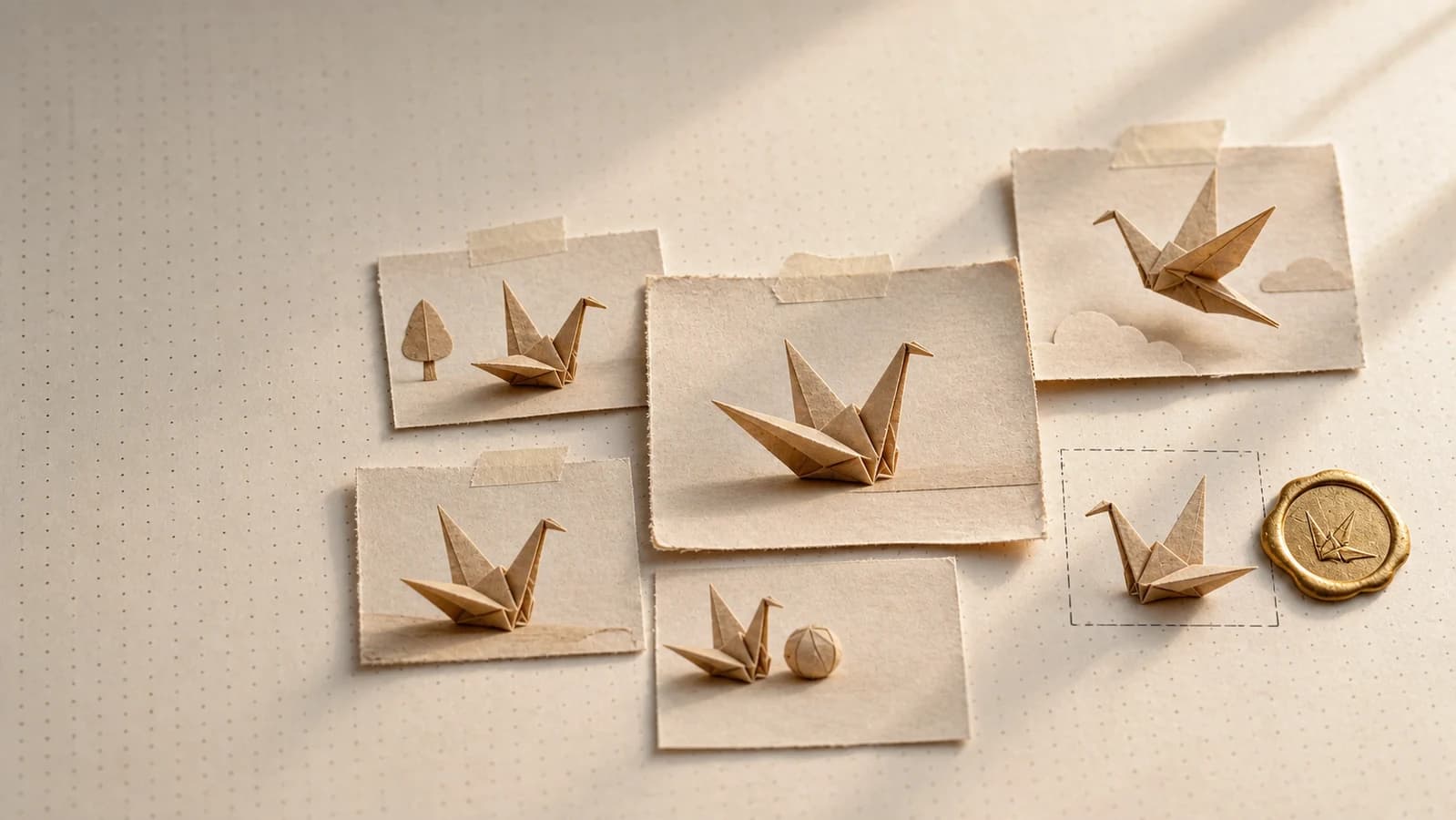
A consistent AI character keeps the same face, hair, build, and outfit across many images (different poses, scenes, and angles) instead of being redrawn from scratch each time. Getting there isn't about writing a better description. It's about giving the model something to hold onto. This piece covers why characters drift, the methods that fix it in 2026, and how to keep a mascot on-model when you're producing at volume.
Why does an AI character look different in every image?
Most text-to-image models treat each generation as a clean slate. They read your prompt, sample from everything they learned in training, and paint a picture, with no memory of the one before. A line like "friendly robot mascot, blue, round eyes" still has thousands of valid answers, so the model picks a new one each run. Nothing is broken; you just never asked for that robot specifically, because words can't point at a specific face the way an image can.
This is the same root cause behind most off-brand AI output: the model fills the gaps you didn't specify with its own averages. We unpack that drift in detail in why your AI content looks off-brand. Character consistency is that problem at its sharpest: a mascot has exactly one correct face, and "close enough" reads as wrong.
So the fix isn't a more detailed prompt. It's anchoring the model to a fixed reference of the character, then reusing that anchor on every generation.
How does consistent-character generation actually work?
There are three main ways to hold a character steady in 2026, and they trade off setup effort against control.
The first is reference-based generation: you hand the model an image of your character and it carries the features into new scenes. Midjourney's Character Reference is a clear example. In its own words, "A Character Reference allows you to recreate a specific character in multiple images," recognizing "the character's features, like hair color, clothes, and facial traits" and reusing them (Midjourney Docs). No training, works in seconds, good for most marketing uses.
The second is fine-tuning, where you teach the model the character itself. The foundational method here is DreamBooth, from a Google Research team. Given "just a few images of a subject," they "fine-tune a pretrained text-to-image model such that it learns to bind a unique identifier with that specific subject," which then lets you "synthesize novel photorealistic images of the subject contextualized in different scenes" (Ruiz et al., CVPR 2023). After training, a single keyword recalls your exact character across "diverse scenes, poses, views and lighting conditions." More setup, but the strongest hold: the model knows the character rather than approximating from a photo.
The third is identity embedding: the tool turns your character into a compact identity it can re-apply on demand, somewhere between the speed of references and the precision of training. Many "save a character" features and lightweight character models work this way under the hood.
| Method | Setup | Best for | Trade-off |
|---|---|---|---|
| Reference image | Seconds, upload and go | Most marketing, quick turnarounds | Holds the look, not every fine detail |
| Fine-tuning (e.g. DreamBooth) | Train once on a few images | Heavy reuse, a recurring spokesperson | Up-front time and compute |
| Identity embedding | Save the character once | Repeated runs of the same character | Varies by tool; less control than full training |
You don't have to pick forever. A common path is to start with a reference image to nail the design, then fine-tune or save it once the character earns a permanent spot.
How consistent can a character really be?
Very, but not perfectly, and the honest tools say so. Midjourney notes that "intricate details like specific freckles or logos on clothing might not come out exactly right," and that references guide new creations "as inspiration… not to copy them exactly" (Midjourney Docs). That's the right mental model for any method: the big identity cues (face shape, hair, color palette, silhouette) lock in reliably, while tiny specifics can wobble run to run.
For a brand mascot, that distinction matters. The features people actually recognize a character by are exactly the ones that hold well. The wobble shows up in the details a viewer won't clock unless they're comparing side by side: a slightly different button, a logo that smears. So the practical rule is: lock the identity with a reference or a trained model, then check and fix the small stuff before anything ships. Consistency is a strong starting point you verify, not an autopilot you trust blindly.
When do you need a consistent character, and when don't you?
You need one when the same character recurs and viewers are meant to recognize it: a brand mascot, a series of explainer illustrations, a recurring spokesperson, a comic or storybook, a set of how-to steps starring the same figure. Anywhere the repetition is the point, drift quietly erodes trust.
You don't need the full apparatus for one-off imagery: a single hero shot, a background, an abstract texture, a stock-style scene with no recurring subject. Setting up a trained character for a picture you'll use once is effort spent on a problem you don't have. Match the method to how many times the character has to come back.
How this looks in Orisu
A character only stays on-model if the whole process stays the same: same reference, same model, same brand inputs, every run. That repeatability is what Orisu is built for. You set your character and brand inputs once on the canvas, wire them into the steps that generate each asset, and save the whole thing as a template. Run it again next week and the same character comes out the other side, because the workflow is fixed, not rebuilt from memory each time.
Pairing the character with your brand kit closes the loop: the mascot holds its identity while the colors, type, and style around it stay on-brand too. And because the workflow is saved, a teammate or freelancer can run it and get your character, not their interpretation of it. The model handles the drawing; the workflow handles the consistency. For more on locking brand inputs into every generation, the on-brand AI content guide is the hub, and what is an AI brand kit covers the inputs side.
A consistent character is one of the clearest wins in on-brand AI: get the anchor right once, reuse it everywhere, and your mascot stops being a fresh stranger in every post.
Your brand kit is one URL away.
Paste your site and Orisu builds the kit — colors, fonts, voice, logo — then holds every generation to it.
Common questions.
What is a consistent AI character?
A consistent AI character is one that keeps the same face, hair, build, and outfit across many generated images (different poses, scenes, and angles) instead of being redrawn from scratch each time. You get a recognizable, repeatable character you can place anywhere, which is what makes it usable as a brand mascot or spokesperson.
Why do AI characters look different in every image?
Most text-to-image models build each picture fresh from your words alone, with no memory of the last one. A prompt like 'friendly robot mascot' has thousands of valid answers, so you get a different robot every run. To hold a character steady you have to give the model a reference (an image, a fine-tuned identity, or a saved character), not just a description.
How do I keep an AI brand mascot consistent across images?
Lock the character to a reference instead of re-describing it. The fastest route is a reference image the model pulls features from; for heavy use, fine-tuning teaches the model the character so a single keyword recalls it. Then run every generation through the same setup so the face, colors, and style stay fixed each time.
Can AI characters be perfectly consistent?
Not perfectly. Reference-based tools openly note that fine details like specific freckles or a logo on clothing may not come out exactly right each time. Treat consistency as very high but not absolute: lock the big identity cues with a reference, expect to fix small details, and keep a human eye on anything going out the door.